Google’s 2026 Review Policy Just Banned These Common Tech Incentive Practices
If your shop runs a technician review program with review quotas, asks customers to mention a specific staff member by name, or applies on-premises pressure, stop.
Those mechanics just became formal violations of Google’s Maps review manipulation policy.
Google’s enforcement systems are already removing reviews, stripping ratings, and hitting profiles with restrictions.
Bottom line: Google rolled out three separate changes to its review rules in early 2026. The February refresh sharpened the text on on-premises review pressure, moving it into active enforcement. On April 16, Google published its 2025 Trust and Safety Report and announced Gemini-powered moderation. The next day, April 17, Google quietly rewrote the Maps Rating Manipulation policy text itself.
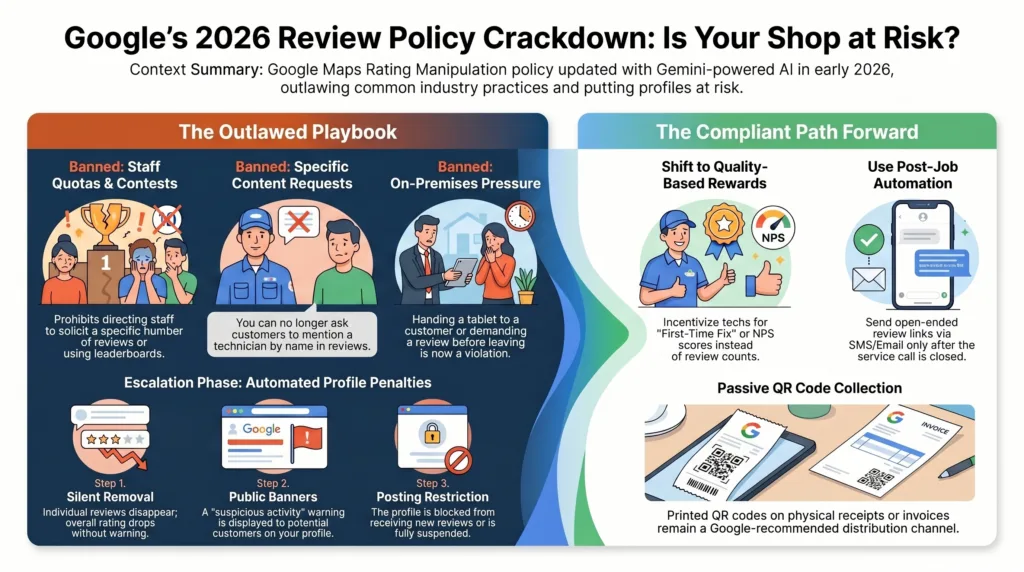
Three practices that used to be standard in home services now fall under explicit policy prohibitions:
- Directing staff to solicit a specific number of reviews (April 17 rewrite)
- Directing staff to request reviews with specific content, including mentions of a staff member by name (April 17 rewrite)
- Pressuring customers to leave reviews while they’re still on-site (February refresh)
Google’s 2025 Trust and Safety Report confirmed 292 million policy-violating reviews were blocked or removed last year. Enforcement is now running on Gemini-powered moderation. Most home service owners have no idea that any of this happened.
The Home Services Review Playbook Just Got Outlawed
Walk into any mid-sized plumbing, HVAC, or electrical shop in North America. Pull up the review tracking dashboard. You’ll see the same pattern every time: reviews per tech, a bonus column, a leaderboard on the wall. Service Titan, Housecall Pro, Jobber, every major trades CRM has this feature baked in because it’s how the industry has operated for a decade.
That specific version of the model is now non-compliant.
The April 17 policy rewrite added two clauses. The first prohibits directing staff to solicit a specific number of reviews. The second prohibits directing staff to request reviews that include specific content, and Google’s policy explicitly lists naming a staff member as an example of that violation. Both practices are the backbone of every commission-based review program in the trades. If Dave the tech gets twenty bucks for every review that mentions “Dave,” both sides of that transaction now violate policy.
Here’s what that actually costs you.
A restricted profile doesn’t just lose you reviews. Based on the ranking patterns we see across client profiles, restriction correlates fast with lost local pack visibility. Home services run on map pack real estate. A profile that stops accepting new reviews or has existing reviews unpublished tends to drop in local ranking quickly. Lead flow craters. For a shop doing five million in annual revenue with 40% of leads sourced through Google Maps, a ninety-day restriction could conservatively model out to mid-six-figure lost bookings before full restoration.
And good luck explaining to your techs why their Q2 bonus just evaporated.
What Actually Changed: Three Moments, Ten Weeks Apart
Google stacked three events in quick succession. Most coverage only addressed one of them. Here’s the full picture.
February 2026: On-Premises Pressure Moves Into Active Enforcement
Google had long discouraged review kiosks and driveway tablet asks, but the language was soft. On February 20, 2026, Barry Schwartz at Search Engine Roundtable reported the policy text had been updated. The new language stated that when soliciting reviews, merchants should not require or pressure users to leave ratings while on the premises, nor should they request that specific content be included.
Translation: the tablet at the front desk, the “scan this QR code before you leave” kiosk, the tech handing the customer a phone in the driveway. All formally non-compliant now, and enforced in a way they weren’t a year ago.
The February update also tightened incentivized-review language. Offering a discount, free service, loyalty points, or any other benefit in exchange for a review is prohibited. The ban extends to offering incentives for a customer to revise or remove a negative review. If a one-star lands and you offer a refund to make it go away, that’s a violation the customer can report.
April 16, 2026: The Tools Announcement
Bibek Samantaray, Google’s Group Product Manager for User Generated Content, published the 2025 Trust and Safety Report on The Keyword blog. The announcement named the enforcement machinery that had been rolling out through Q1:
- Gemini-powered moderation now handles place edits and review content evaluation at scale.
- Pre-publication detection identifies coordinated fake review campaigns and review extortion before they publish.
- The 292 million removals stat came out of this report.
Google also described the enforcement actions it applies when it sees spam-review spikes on a profile: removing suspicious reviews, pausing new reviews, alerting the profile owner, and displaying a notification banner to searchers.
Naming Gemini as the moderation model matters. Frontier-class AI at Google’s deployment scale changes the economics of pattern detection across AI-powered local search surfaces and traditional Maps enforcement alike.
April 17, 2026: The Quiet Policy Rewrite
The next day, Google updated the actual text of the Maps Rating Manipulation policy without a press release. Local SEO consultant Amy Toman spotted the change on LinkedIn before official documentation circulated. The two new prohibitions:
- Directing staff to solicit a specific number of reviews (quotas, contests, per-tech incentives tied to review counts)
- Directing staff to request reviews that include specific content, with staff-name mentions listed as an example
The second clause is broad enough that practitioners like Miriam Ellis have flagged open questions about scope. Does “tell us about the duct cleaning service in your review” count? Probably. Until Google publishes clarifying guidance, the safe answer is yes. Keep every review ask completely open-ended.
How Google Tracks and Enforces This
Based on Google’s public policy language, the 2025 Trust and Safety Report, and the patterns we see across client profiles, here’s the enforcement picture.
Enforcement isn’t a human team spot-checking complaints. It’s machine learning, running continuously, cross-referencing signals at scale.
Signals we’d expect Gemini-class moderation to weight heavily:
Linguistic clustering. If twelve reviews posted in sixty days all mention “ask for Mike” or “Mike did a great job” with similar sentence structure, that’s a detection pattern. Frontier LLMs are very good at spotting templated language even when wording varies slightly across reviews.
Velocity spikes. A profile that jumps from two reviews a month to twenty-five gets flagged. Google’s documented behavior is to hold suspicious reviews in an extended scrutiny period while the system evaluates them.
IP and location clustering. If reviewer accounts leaving reviews for your shop cluster near your business location, a common pattern when employees, family, or friends are prompted, Google may display a public notification banner on your profile alerting searchers to suspicious activity.
Named-entity pattern matching. Identifying a specific employee name appearing across dozens of reviews in a short window is a well-understood NLP task. At Google’s scale and with Gemini doing the work, it’s a cheap signal to extract.
Cross-profile correlation. If the same reviewer leaves five-star reviews for your company, your buddy’s company, and three other home service shops in the same city, Google can connect those dots.
The Enforcement Escalation We See
Google publishes the individual actions (review removal, review pauses, owner alerts, notification banners, posting restrictions) but doesn’t publish a fixed sequence. Based on what we observe across client profiles, the escalation typically runs in this order:
- Silent review removal. Individual reviews disappear. The rating drops but the profile stays functional.
- Extended scrutiny period. New reviews take longer to publish or get held while the system evaluates them.
- Public notification banner. A notice appears on the profile alerting searchers to suspicious review activity. Most often triggered by velocity spikes and location clustering.
- Posting restriction. The profile can’t receive new reviews or ratings for a set period of time.
- Review unpublishing. Existing reviews get unpublished for a set period. Years of 4.8-star rating can become invisible overnight.
- Profile suspension. Full delisting from Google Maps and local search.
Check your Google Business Profile dashboard regularly for status messages on the Reviews section. Enforcement indicators tend to appear there before anywhere else.
The Compliant Playbook That Still Works
Google still wants you to collect reviews. The policy explicitly allows soliciting content that represents a genuine experience, as long as no incentive is offered and no specific content is requested. Here’s what that looks like operationally for a home services business:
- Send an automated SMS or email after the job closes out. Include a direct link to your Google review page. Don’t mention specific content. Don’t mention staff names. Don’t offer anything in return.
- Use QR codes on invoices, receipts, or post-service leave-behinds. Google’s own help documentation, published in December 2025, specifically lists receipts, thank-you emails, end-of-chat messages, and printed QR codes in physical locations as recommended distribution channels.
- Respond to every review, positive and negative. Most local SEO practitioners treat response engagement as a trust and completeness signal that supports profile performance, and it builds conversion with future customers either way.
- Reward your techs for service-quality metrics that drive reviews indirectly: first-time fix rate, customer callback rate, net promoter score, upsell conversion, on-time arrival. Tie bonuses to the outcomes that produce good reviews, not the reviews themselves.
That last point is the real shift. The industry has been paying for the symptom (review count per tech) instead of the cause (service quality per tech). The policy update forces the alignment that should have been there the whole time.
Frequently Asked Questions
Can I still ask customers to review my HVAC or plumbing company?
Yes. Google explicitly allows merchants to solicit reviews that represent a genuine experience. What you can’t do is ask for specific content, mention staff names, tie the ask to an incentive, or pressure the customer while they’re still on-site. A follow-up text or email with a review link after the job closes is fully compliant.
What happens to my existing reviews that already mention my technicians by name?
Genuine customer reviews that voluntarily mention your techs aren’t the target of the policy update. The April 17 rewrite addresses merchant behavior (directing staff to request name mentions), not the content of past reviews a customer chose to write. Those stay up. The risk zone is ongoing solicitation that matches the new banned patterns, not historical content. That said, if a cluster of older reviews all follow the same script or show other manipulation signals, Gemini-powered moderation could still flag them during a sweep. Clean collection going forward is the real protection.
Does Google actually detect when reviews mention employee names?
Named-entity recognition is a mature NLP capability, and Gemini-powered moderation makes pattern detection at scale straightforward. A shop running an “ask for Dave” program where the same name appears across many reviews in a short window fits the kind of pattern these systems are built to surface.
My CRM generates tech-specific review links that include the technician’s name. Is that a problem?
It’s in the gray zone, and we’d treat it as risky until Google clarifies. A review link tied to a specific technician arguably directs specific content (the tech’s identity) by design, even if the customer writes the review freely. The safer setup is a company-level review link that points to your general GBP review page. Most of the major trades CRMs (Service Titan, Housecall Pro, Jobber) support both options. Audit which one your automations are using this week.
What happens if my Google Business Profile gets restricted?
Depends where on the escalation you land. Silent review removal and extended scrutiny periods are the most common. More serious violations can trigger public notification banners visible to searchers, posting restrictions that block new reviews for a set period, or unpublishing of existing reviews. Full suspension is the worst case. All of these hit map pack visibility and, therefore, home services lead volume.
How do I know if my profile is already under enforcement action?
A few signals to check. Pull your Reviews section and look for status messages or banners. Compare your monthly review volume to your six-month average, a sudden unexplained drop often means silent removal is happening. Check whether reviews you remember approving are still visible. Watch for unusual gaps in your review timeline.
Most owners can’t self-diagnose this cleanly because the enforcement signals are subtle and the data lives across multiple dashboards. If you suspect something’s already off, book a complimentary strategy session and our local SEO team will audit your profile, flag any active enforcement indicators, and map the compliance gaps against the 2026 policy updates.
Can I still run a tech recognition program that drives reviews?
Absolutely, and this is the fix most shops need. Reward your techs on service-quality metrics that correlate with reviews: first-time fix rate, customer callback rate, NPS score, on-time arrival percentage. You get the same behavior change without the policy risk, and you stop paying for the symptom.
Is a QR code on the invoice still compliant?
Yes. Google’s December 2025 help documentation names QR codes in physical locations and printed review links on receipts as recommended distribution channels. The compliance line is context. A QR code the customer takes home and scans on their own time is fine. A tech holding a tablet in the driveway asking the customer to scan before leaving falls under on-premises pressure, which the February refresh formally prohibits.
How often should I audit my GBP for policy changes?
Quarterly at minimum, and any time a major policy update ships. Three changes landed in the first four months of 2026 alone, and most operators are still running review programs that became violations ten weeks ago. If your last audit predates the February update, it’s overdue.
This Is a Specialist Problem Now
Google Business Profile optimization stopped being a set-it-and-forget-it task around 2023. Between policy updates, Gemini-powered enforcement, category changes, Local Services Ads review consolidation, and the new AI answer surfaces pulling directly from GBP data, the profile is now a living system that needs active management.
At Digital Shift, we audit GBP profiles for home service operators every week. The same pattern shows up over and over. A review collection program that was compliant eighteen months ago is a policy violation today, and the owner has no idea. We fix the review collection flow, tighten category and attribute strategy, build a compliant tech recognition program that still motivates the team, and keep the profile ahead of the next policy shift.
If your GBP hasn’t been audited since the February 2026 update, it’s overdue.
Download our free Google Business Profile Optimization Checklist. It’s the exact checklist our local SEO team runs against every client profile during onboarding. Covers review policy compliance, category strategy, the 2026 AI search surface changes, and the specific signals that drive map pack ranking for home services companies.